



The way customers search has fundamentally changed. When someone asks an AI for a recommendation. Your business needs to be the answer. That's exactly what Answer Engine Optimization delivers.
Think about the last time someone in your world needed a service provider, a software tool, or a local business. Did they open Google? Or did they as ChatGPT, Perplexity, or Claude?
Millions of people are now typing questions like "What's the best marketing agency for ecommerce? or "Which CRM should a small law firm use? directly into AI tool, and those tools are answering with specific brand recommendations.
The businesses showing up in those answers didn't get there by accident. They got there because they understood Answer Engine Optimization and they got ahead of the curve.
What is the best digital marketing agency for growing a B2B brand in 2026?
This is the type of query that drives real buying decisions. Our job is to make sure your business gets names when an AI answers it.
Traditional SEO gets you ranking on a list of ten blue links. AEO gets you mentioned by name when an AI has a conversation with your potential customer. That's a fundamentally different and far more powerful kind of visibility.
When ChatGPT pulls together an answer about the best bookkeeping software for freelancers, or the top personal injury attorneys in Austin, it's drawing from the content it has been trained on and the sources it continues to retrieve in real time. Answer Engine Optimization is how you make sure your brand is woven into that fabric.
It's not magic. It's not manipulation. It's a structured, strategic approach to making your content so clear, so authoritative, and so well-organized that AI engines choose your business as the answer. Here's exactly how we do it.
We don't spray and pray. Every strategy we run is built around the signals that AI systems actually use to evaluate and recommend businesses.
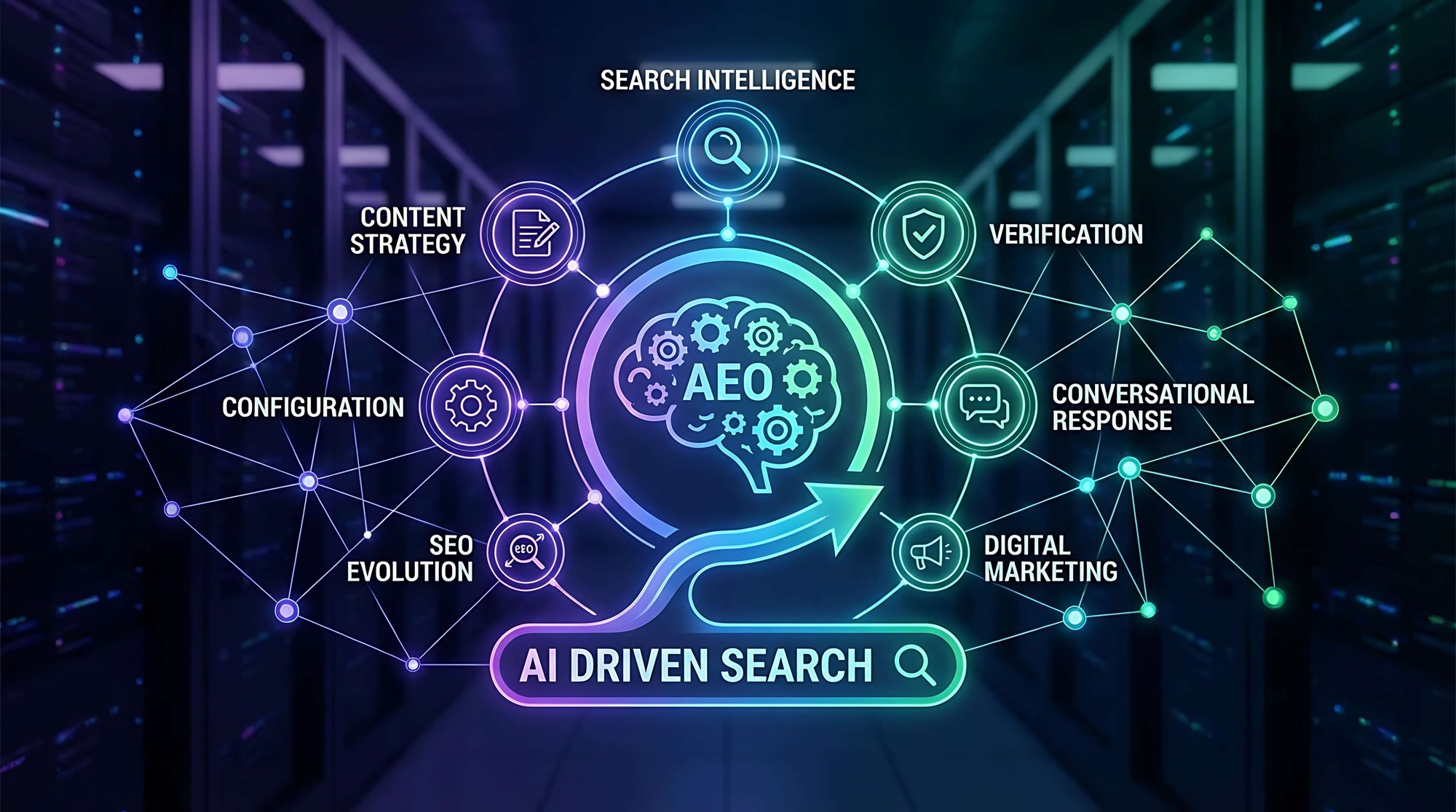
AI systems love content they can scan and extract clean answers from. We restructure your existing content and create new content using clear lists, comparison tables, short focused paragraphs, and direct question-and-answer formats.

We build dedicated FAQ pages that map directly to the specific queries your ideal customers are asking AI tools. These aren't generic "frequently asked questions", they're precision-targeted pages that answer real "how-to" and "what is" questions in your industry.

Schema markup is structured code added to your website that helps AI engines understand your content in context, not just as text on a page, but as meaningful, categorized information about your business, your products, your reviews, and your expertise.

People talk to AI differently than they type into Google. They ask full questions: "What's the best restaurant near me for a business dinner?" or "Who should I call if I'm starting an LLC in Nashville?" We optimize your content around these conversational, intent-rich queries.
AI tools don't recommend businesses randomly. They recommend sources that demonstrate Experience, Expertise, Authoritativeness, and Trustworthiness, Google's E-E-A-T framework, which now extends directly to how AI systems evaluate credibility.
AI Visibility Audit
We test how your brand currently appears (or doesn't) across CHatGPT, Claude, Perplexity and Google AI Overviews. We map the gaps and identify your highest-value opportunities.
Query & Topic Mapping
We identify the exact questions your ideal customers are asking AI tools and build a content architecture that positions you brands as the definitive answer to each one.
Content & Technical Execution
Our team implements structured content schema markup, FAQ pages, and E-E-A-T signals across your digital presence. It's all optimized for AI retrieval and recommendation
Monitoring & Iteration
We identify the exact questions your ideal customers are asking AI tools and build a content architecture that positions you brands as the definitive answer to each one. We track your AI visibility over time, test new queries monthly, and continuously improve your positions as AI search behavior evolves.
Still figuring out if AEO is right for your business? Here are the questions we hear the most.
Traditional SEO optimizes for a ranked list of links on a search engine results page (SERP). Answer Engine Optimization optimizes for direct, spoken-style answers delivered by AI tools like ChatGPT, Claude and Perplexity. The goal isn't to rank, it's to be cited and recommended by name. The strategies overlap in places, but the intent, format and measurement are fundamentally different.
Most clients start seeing measurable improvements in AI visibility within 60 to 90 days. That said, AEO is a compounding strategy, the longer your content and authority signals are in place, the more consistently AI systems recommend you. We track progress monthly using live AI query testing across the major platforms.
Yes, but some categories benefit more immediately than others. If your customers research buying decisions online before purchasing, or if you operate in a service category where people ask for recommendations (legal, financial, medical, software, home services, agencies), AEO can have a significant impact on your pipeline. We'll tell you during the audit phase exactly how big the opportunity is for your specific market.
Almost never. In most cases, we restructure and optimize what you already have — adding schema, rewriting intros, creating FAQ sections, and building supplementary content around high-value queries. The audit tells us exactly what needs to be built versus refined.
Generative Search Optimization (GSO) is another term for what we do, optimizing your presence for AI systems that generate conversational answers rather than returning link lists. It's the same discipline as AEO, sometimes also called Large Language Model Optimization (LLMO) or AI Search Optimization. Different names, same goal: get your business into the AI-generated answer.
Let's run a free AI visibility audit and show you exactly where your brand stands, and what it would take to own the answer in your category.