The Role of AI in Performance Marketing: Beyond the Hype to Real-World Results

By Jessica Spear, C.I.S. Digital, LLC
Artificial Intelligence (AI) is revolutionizing performance marketing by enabling businesses to optimize their marketing strategies through data-driven insights and automation. This article delves into the various ways AI enhances marketing performance, focusing on real-world applications and measurable outcomes. Readers will learn about the mechanisms behind AI marketing automation, the tools available, and the strategies that can be employed to achieve significant results. As businesses face increasing competition and the need for personalized marketing, AI offers solutions that not only streamline processes but also improve customer engagement and ROI. We will explore key strategies, tools, and case studies that illustrate the transformative impact of AI in performance marketing.
Strategies
Leveraging AI in performance marketing involves a variety of strategies that enhance campaign effectiveness and efficiency. These strategies include the integration of AI-driven tools that analyze consumer behavior, optimize ad placements, and personalize content delivery. The importance of Answer Engine Optimization (AEO) cannot be overstated, as it ensures that marketing efforts align with user intent, leading to higher engagement rates. Additionally, integrating AI with existing marketing efforts allows businesses to harness the power of data analytics, enabling them to make informed decisions that drive results.
Tools
Several tools facilitate AI-driven marketing, each designed to enhance specific aspects of campaign management. These tools range from predictive analytics platforms to automated content creation software. For instance, machine learning algorithms can analyze vast amounts of data to identify trends and patterns, allowing marketers to tailor their strategies accordingly. Other tools focus on automating repetitive tasks, freeing up valuable time for marketers to concentrate on creative and strategic initiatives. Successful implementations of these tools have demonstrated significant improvements in campaign performance and customer satisfaction.
Case Studies
Real-world examples of AI in performance marketing highlight its effectiveness in driving measurable results. Companies that have adopted AI-driven strategies report increased conversion rates and improved customer retention. For instance, a leading e-commerce platform utilized AI to personalize product recommendations, resulting in a reported increase in sales. Another case study involved a financial services firm that implemented predictive analytics to enhance customer targeting, leading to improved ROI. These success stories illustrate the tangible benefits of integrating AI into marketing strategies.
How Does AI Marketing Automation Enhance Campaign Optimization?
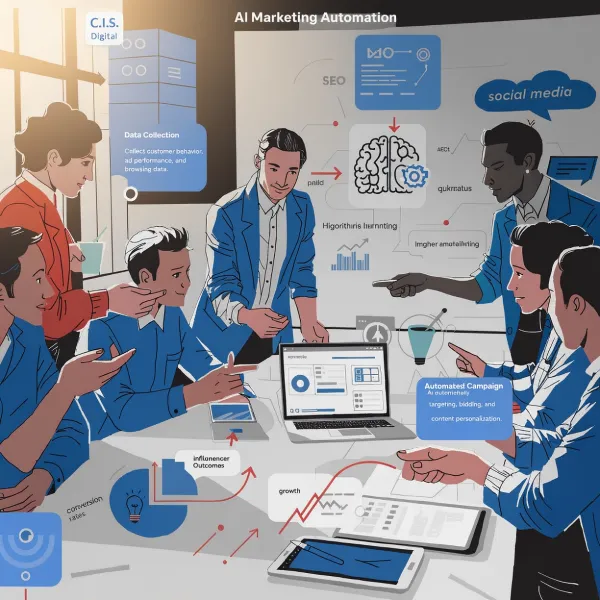
AI marketing automation enhances campaign optimization by utilizing advanced algorithms to analyze data and predict consumer behavior. This process allows marketers to create highly targeted campaigns that resonate with their audience. By automating repetitive tasks, AI frees up time for marketers to focus on strategy and creativity. The benefits for marketers include improved efficiency, reduced costs, and the ability to scale campaigns quickly. As AI technology continues to evolve, its implications for future marketing strategies are profound, promising even greater levels of personalization and effectiveness.
What Machine Learning Techniques Drive Digital Marketing Efficiency?
Machine learning techniques play a crucial role in driving digital marketing efficiency. These techniques include supervised learning, unsupervised learning, and reinforcement learning, each offering unique advantages. Supervised learning, for example, allows marketers to train algorithms on historical data to predict future outcomes, while unsupervised learning helps identify hidden patterns in consumer behavior. By leveraging these techniques, businesses can enhance their marketing strategies, leading to more effective campaigns and improved customer engagement.
Indeed, machine learning techniques are proving instrumental in optimizing programmatic advertising through predictive ad targeting, leading to higher click-through and conversion rates.
ML for Predictive Ad Targeting & Conversion Optimization This study explores the potential of machine learning (ML) techniques to enhance predictive ad targeting within the programmatic advertising ecosystem. By applying a range of supervised and unsupervised ML models, including decision trees, neural networks, and clustering algorithms, we assess the ability of these models to improve ad relevance and engagement while optimizing budget allocation. Our findings reveal that ML-driven predictive targeting significantly increases click-through rates (CTR) and conversion rates compared to conventional targeting strategies. Optimizing programmatic advertising: A machine learning approach to predictive ad targeting, A Singhal, 2024
How Predictive Analytics Improves Targeting and ROI in Campaigns
Predictive analytics significantly improves targeting and ROI in marketing campaigns by analyzing historical data to forecast future trends. This approach enables marketers to understand customer behavior better and tailor their messaging accordingly. For instance, businesses can identify which segments of their audience are most likely to convert, allowing for more efficient allocation of resources. By optimizing content for AI retrieval, companies can enhance their visibility and engagement, ultimately leading to higher returns on investment.
Further research underscores how predictive analytics and AI significantly enhance digital marketing strategies and ROI through improved engagement and conversions.
AI & Predictive Analytics for Digital Marketing ROI The study explores the effects of artificial intelligence (AI) and predictive analytics on digital marketing strategy and return on investment (ROI). It reviews relevant literature on the use of AI and predictive analytics in digital marketing, focusing on email marketing, customization, social media marketing optimization, and consumer segmentation. The findings highlight the significant impact of predictive analytics and AI on digital marketing strategy and ROI, with businesses that effectively utilize these technologies reporting higher engagement, conversions, and revenue growth. The impact of predictive analytics and AI on digital marketing strategy and ROI, MA Al Khaldy, 2023
What Are the Key Applications of Programmatic Advertising AI in Real-Time Marketing Optimization?
Programmatic advertising AI plays a vital role in real-time marketing optimization by automating the buying and selling of ad space. This technology allows advertisers to target specific audiences with precision, ensuring that their messages reach the right people at the right time. Key applications include real-time bidding, which enables advertisers to bid on ad placements in milliseconds, and automated content personalization, which tailors ads to individual user preferences. These applications not only enhance campaign effectiveness but also improve overall marketing efficiency.
How Does Real-Time Bidding Utilize AI for Performance Gains?
Real-time bidding (RTB) utilizes AI to analyze vast amounts of data in real-time, allowing advertisers to make informed decisions about ad placements. By leveraging machine learning algorithms, RTB platforms can predict which impressions are likely to yield the highest returns, optimizing ad spend. This process results in significant performance gains, as advertisers can target their audiences more effectively and reduce wasted ad spend. The ability to adjust bids dynamically based on real-time data further enhances the effectiveness of marketing campaigns.
What Role Does AI Play in Automated Content Personalization?
AI plays a crucial role in automated content personalization by analyzing user data to deliver tailored experiences. This technology enables marketers to create dynamic content that adapts to individual preferences and behaviors. For example, AI algorithms can recommend products based on past purchases or browsing history, enhancing the customer experience and increasing conversion rates. By implementing automated content personalization, businesses can foster deeper connections with their audience, ultimately driving loyalty and engagement.
Studies confirm that AI-driven content personalization is a powerful tool for boosting user engagement and conversion rates in digital marketing campaigns.
AI Personalization for Digital Marketing Success This study examines the effectiveness of AI-driven content personalization on enhancing the user engagement and increasing the conversion rates within digital marketing campaigns. It contributes to digital marketing field by highlighting how the personalized content significantly boosts user interaction. The findings suggest that AI personalization strategies are key to elevating engagement, emphasizing the need for ethical considerations in AI implementations. This research enriches the understanding of AI’s role in digital marketing, encouraging further exploration into ethical and user-centered personalization approaches. By integrating empirical evidence with theoretical insights, the study presents a nuanced perspective on AI’s potential to improve the digital marketing strategies, focusing on user engagement optimization. AI-Powered Personalization: Transforming Digital Marketing Campaigns for Success, TA Hmeidan, 2024
Which Metrics Demonstrate the Impact of AI on Marketing Performance?

Several key metrics demonstrate the impact of AI on marketing performance, including conversion rates, customer acquisition costs, and return on investment (ROI). These metrics provide valuable insights into the effectiveness of AI-driven strategies and help marketers assess their performance. By utilizing AI-powered attribution models, businesses can gain a clearer understanding of how different marketing channels contribute to overall success. This data-driven approach allows for more informed decision-making and continuous improvement in marketing efforts.
How Do AI-Powered Attribution Models Enhance Campaign Measurement?
AI-powered attribution models enhance campaign measurement by providing a more accurate representation of how various touchpoints influence customer behavior. Traditional attribution models often fail to account for the complexity of the customer journey, leading to misallocated resources. In contrast, AI-driven models analyze data from multiple sources to identify the true impact of each channel. This comprehensive view enables marketers to optimize their strategies and allocate budgets more effectively, ultimately improving campaign performance.
What ROI Improvements Are Evident from AI-Driven Marketing Strategies?
AI-driven marketing strategies have demonstrated significant ROI improvements across various industries. Companies that have embraced AI report higher conversion rates and reduced customer acquisition costs. For instance, businesses leveraging predictive analytics have seen notable increases in ROI due to more effective targeting and personalized messaging. These improvements highlight the value of integrating AI into marketing strategies, as it allows companies to maximize their resources and achieve better results.
How Can Businesses Implement AI-Driven Marketing Solutions Effectively?
Implementing AI-driven marketing solutions effectively requires a strategic approach that aligns with business goals. Companies should start by identifying specific areas where AI can add value, such as customer segmentation or campaign optimization. Additionally, investing in the right tools and technologies is crucial for successful implementation. Training staff to understand and utilize AI tools effectively will also enhance the overall impact of these solutions. By taking a thoughtful approach to AI integration, businesses can unlock the full potential of their marketing efforts.
What Are Best Practices for Integrating AI Technologies in Marketing Services?
Integrating AI technologies into marketing services involves several best practices that can enhance effectiveness. Key considerations include:
- Data Quality: Ensure that the data used for AI training is accurate and relevant to achieve reliable results.
- Clear Objectives: Define clear goals for AI implementation to measure success effectively.
- Continuous Learning: Stay updated on AI advancements and continuously refine strategies based on new insights.
By following these best practices, businesses can maximize the benefits of AI technologies in their marketing efforts.
Challenges and Ethical Considerations in AI Performance Marketing
While AI delivers measurable gains in efficiency, targeting, and personalization, its implementation is not without complexity. A balanced approach to AI adoption requires you to understand the operational challenges and ethical implications that accompany these technologies, so you can deploy them responsibly while sustaining long-term trust with your audience.
Data Privacy and Consumer Trust
AI-driven marketing depends on large volumes of consumer data, which raises important questions about how that data is collected, stored, and used. You are responsible for ensuring that data practices comply with applicable privacy regulations and that consumers understand how their information informs personalized experiences. Transparent data policies, clear consent mechanisms, and secure data handling are essential to maintaining consumer trust as AI-driven targeting becomes more sophisticated.
Algorithmic Bias and Transparency
AI models are only as objective as the data used to train them, and biased or incomplete datasets can lead to skewed targeting, unequal ad delivery, or messaging that fails to resonate with certain audience segments. Regularly auditing algorithms, diversifying training data, and maintaining transparency around how automated decisions are made help you identify and correct these issues before they affect campaign outcomes or brand reputation.
Balancing Automation with Human Oversight
Over-reliance on automation can result in messaging that feels impersonal or misaligned with brand voice if left unchecked. You should treat AI as a tool that supports, rather than replaces, strategic decision-making. Maintaining human oversight of AI-generated content and recommendations ensures that campaigns remain aligned with business objectives, ethical standards, and the nuanced judgment that fully automated systems cannot replicate.
Addressing these challenges directly allows you to capture the efficiency and precision AI offers while safeguarding the trust and credibility that sustainable marketing performance depends on.
How Does C.I.S. Digital support AI Marketing Automation Deployment?
C.I.S. Digital specializes in supporting businesses with AI marketing automation deployment. The agency offers a range of services designed to convert businesses seeking marketing solutions into customers. With a focus on data-driven marketing solutions, C.I.S. Digital leverages advanced technologies to enhance campaign performance. Their expertise in AI-driven strategies ensures that clients can effectively implement and benefit from marketing automation, leading to measurable business outcomes.
What Are Emerging Trends and Future Directions in AI for Performance Marketing?
Emerging trends in AI for performance marketing indicate a shift towards even greater personalization and automation. As technology continues to evolve, predictive customer segmentation is expected to become more sophisticated, allowing for hyper-targeted marketing efforts. Innovations in real-time marketing automation will also enhance the ability to respond to consumer behavior dynamically. These advancements promise to reshape the marketing landscape, providing businesses with new opportunities to engage their audiences effectively.
How Will Predictive Customer Segmentation Evolve with AI Advancements?
Predictive customer segmentation is set to evolve significantly with advancements in AI technology. As algorithms become more sophisticated, businesses will be able to analyze customer data more deeply, identifying nuanced segments based on behavior and preferences. This evolution will enable marketers to create highly personalized campaigns that resonate with specific audience segments, ultimately driving engagement and conversion rates.
What Innovations Are Anticipated in Real-Time Marketing Automation?
Anticipated innovations in real-time marketing automation include enhanced AI capabilities that allow for more responsive and adaptive marketing strategies. As AI technology advances, marketers will be able to leverage real-time data to adjust campaigns on the fly, ensuring that messaging remains relevant and impactful. These innovations will empower businesses to stay ahead of the competition and meet the ever-changing demands of consumers.
To learn more about how we can help, contact us today.