

Is Your Brand Using Integrated Marketing?

Is Your Brand Using an Integrated Marketing Strategy to Drive Growth?

Integrated marketing brings a brand’s message, channels and data together into one coordinated program that speeds growth by removing friction across customer touchpoints. In this guide we define integrated marketing for 2025, show how it differs from multichannel and omnichannel approaches, outline measurable benefits, and give a step‑by‑step plan to build an integrated communications program. Many organizations split creative, media buying and analytics — wasting budget and weakening recall. A coherent integrated strategy closes those gaps by aligning objectives, audiences and measurement. Read on for core elements, top benefits with evidence, a practical implementation roadmap with recommended channel mixes, AI enhancements, and measurement frameworks to prove ROI. Expect clear lists, EAV-style tables mapping steps to tools and metrics, and industry examples so you can judge whether your brand is truly integrated or just running disconnected campaigns.
What Is Integrated Marketing and How Does It Differ from Multichannel and Omnichannel Approaches?
Integrated marketing is a strategic approach that unifies messaging, creative and measurement so every touchpoint reinforces the same brand promise. The engine is cross‑channel coordination — shared creative frameworks, single customer profiles and synchronized timing — which produces a consistent brand perception and cleaner attribution. Practically, that means stronger brand salience and more efficient spend because audiences encounter a coherent story across search, social, email and offline. This definition sets up a clear comparison with related approaches and explains why integration matters for sustainable growth. The sections that follow break down the core elements and show how integration improves consistency and the customer experience.
What Are the Core Elements of an Integrated Marketing Strategy?
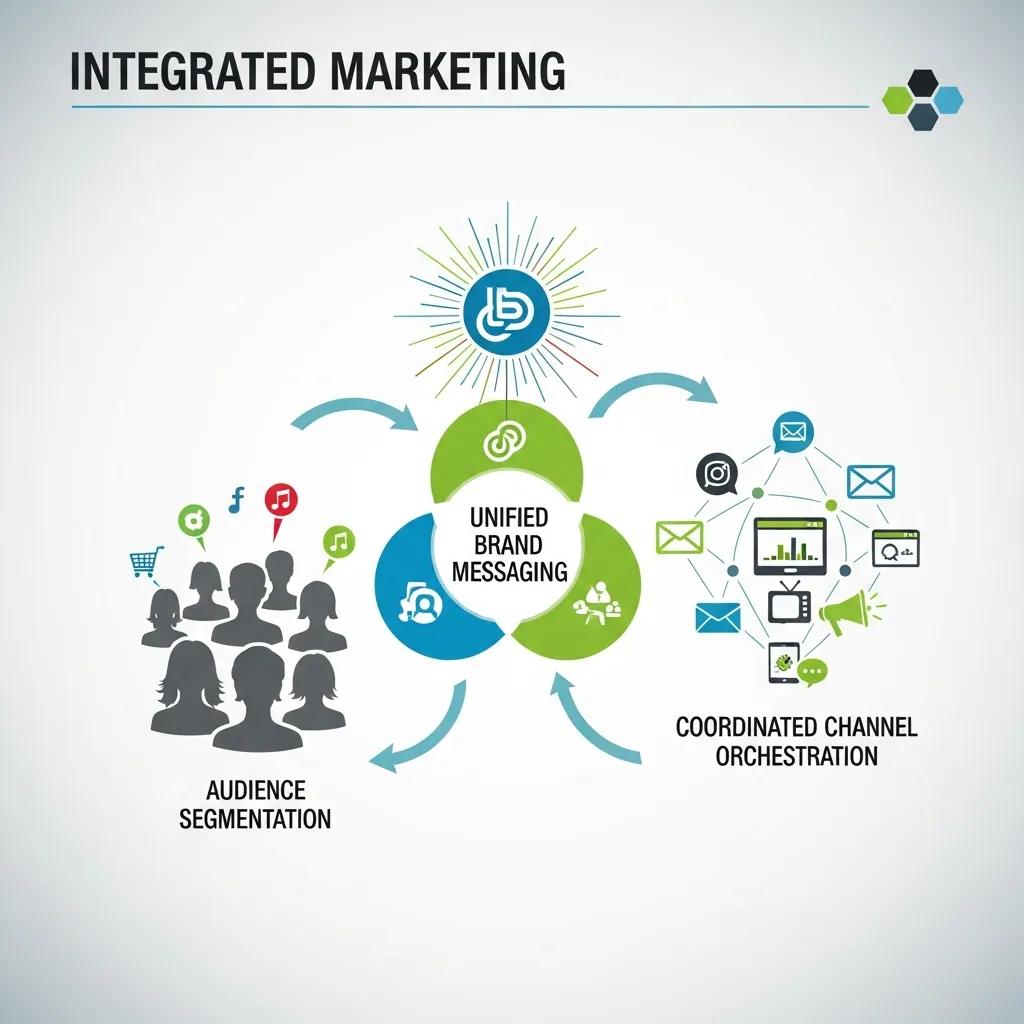
Integrated marketing is built on a few essential elements: unified brand messaging, audience segmentation, coordinated channel orchestration, a content strategy, and shared measurement. Unified messaging keeps your promise and tone consistent whether someone sees a display ad, opens an email, or watches a social clip — which boosts recognition and trust. Segmentation and journey mapping give you the when and where for tailored content; they guide personalized creative and timing. Channel orchestration assigns clear roles to owned, paid and earned media so each contributes to one narrative instead of duplicating effort. Together these elements create the operational foundation for coordinated campaigns and measurable outcomes.
How Does Integrated Marketing Improve Brand Consistency and Customer Experience?
Integrated marketing raises brand consistency by enforcing a single creative and messaging system across channels, reducing customer confusion as people move through the funnel. The tools are shared asset libraries, design systems and brand guidelines that keep visual and verbal alignment — speeding execution and reducing rework. The customer experience improves because messaging is contextual and sequential: awareness creative primes consideration assets, which support conversion and retention. Brands that run integrated campaigns typically see higher recall, smoother conversion paths and lower churn because customers encounter fewer mixed messages. That cohesion also produces cleaner data signals, enabling more accurate measurement and faster optimization.
What Are the Top Benefits of Using Integrated Marketing for Your Brand?
Integrated marketing turns scattered activity into strategic synergy across channels, delivering measurable business value. Key benefits include higher ROI through cross‑channel reinforcement, better brand awareness and credibility from consistent exposure, improved customer experience and lifetime value, operational efficiency from shared creative and data, and clearer measurement that supports faster optimization. Each benefit comes from mechanisms like unified data, shared assets and coordinated timing that cut waste and lift conversion probability. Below are the five primary benefits with concise explanations and the main metric that shows impact for each.
Integrated marketing delivers these top five benefits:
- Higher ROI Through Channel Synergy: Coordinated spend lowers CPA and increases conversion lift when channels echo the same message.
- Stronger Brand Awareness and Credibility: Repeated, consistent exposure across channels builds recognition and trust.
- Improved Customer Experience: Seamless journeys cut friction and raise lifetime value by guiding audiences through tailored touchpoints.
- Operational Efficiency: Shared creative and data pipelines reduce production cost and speed time‑to‑market.
- Cleaner Measurement and Insight: Unified tracking enables more accurate attribution and faster learning loops.
These benefits show how integration converts marketing activity into business outcomes. The table below links each benefit to the mechanism that creates it and the KPI that signals success.
| Benefit Area | Mechanism | Example Metric / Impact |
|---|---|---|
| ROI & Efficiency | Cross‑channel reinforcement and shared creative | Reduced CPA by 10–30% (measured via campaign lift) |
| Brand Awareness | Consistent messaging across paid/owned/earned | Brand recall uplift and CPM efficiency |
| Customer Experience | Journey orchestration and personalization | Increased CLV and reduced churn rate |
| Speed & Ops | Centralized asset management | Faster campaign launch, fewer revisions |
| Measurement | Unified customer profile & attribution | More accurate multi‑touch attribution, clearer incrementality |
This table clarifies how each benefit is realized and which KPIs to watch. With that context, practical planning and execution steps make integration achievable for most brands.
If you prefer external support, high‑level integrated marketing services can translate these benefits into operational programs. A strategic partner focused on holistic brand cohesion synchronizes creative and data to protect consistency, while ROI‑focused teams use channel synergy and advanced analytics to improve outcomes. Leading providers emphasize innovation — especially AI‑driven personalization and analytics — to scale relevance and design journeys that link awareness to retention. These descriptions are intentionally high‑level to show paths to operationalization without prescribing a single solution.
How Does Integrated Marketing Increase ROI and Marketing Efficiency?
Integrated marketing raises ROI by cutting redundant audience overlap, reallocating budget to high‑performing channels, and reusing creative across executions. The levers are shared audience segments, coordinated retargeting windows, and centralized dashboards that reveal cross‑channel interactions. For example, synchronized creative templates reduce production time and speed A/B testing, while unified attribution models highlight which touchpoints deliver incremental conversions. The result: lower CPA, higher conversion rates and stronger ROAS when decisions are driven by integrated data. These efficiency levers also amplify brand awareness and credibility.
In What Ways Does Integrated Marketing Enhance Brand Awareness and Credibility?
Integrated marketing boosts awareness by delivering consistent narratives that compound with each exposure, and it builds credibility when earned and owned content back up paid campaigns. The mechanism is repeat exposure plus trust‑building content — case studies, reviews and thought leadership. Orchestrating video, social and PR in a coordinated cadence expands reach and creates social proof, improving recall and consideration. Measurable outcomes include higher aided and unaided awareness, stronger engagement rates and conversion lift downstream. That awareness foundation makes targeted conversion tactics more effective.
How Can You Develop an Effective Integrated Marketing Plan for Your Brand?
Start with aligned goals and KPIs, then map audiences, choose channels, coordinate creative and set up measurement that supports iterative optimization. The approach is a phased communications plan where each stage — research, strategy, creative production, activation and optimization — has clear owners and success metrics. The outcome is a repeatable roadmap that connects brand objectives to tactical execution so teams can scale without losing coherence. The sections below give a practical how‑to and channel recommendations mapped to roles and tools for straightforward implementation.
Follow these step‑by‑step actions to craft an integrated marketing communications plan:
- Audit Current State: Inventory channels, creative assets and data sources to find gaps.
- Set Goals & KPIs: Define business‑aligned objectives (awareness, leads, revenue) and the metrics that show progress.
- Map Customer Journeys: Build segments and touchpoint sequences for priority personas.
- Plan Channel Mix & Creative: Assign roles across owned, paid and earned media and design unified messaging.
- Implement Tech & Measurement: Standardize tags, deploy a CDP or unified profiles, and choose an attribution framework.
- Optimize Continuously: Run experiments, measure incrementality, and shift budget to top performers.
These steps turn strategy into operational tasks and establish a cadence for continuous improvement. The table below maps phases to recommended tools and team responsibilities to simplify execution.
| Phase | Key Actions | Recommended Tools / Examples |
|---|---|---|
| Audit | Inventory channels and assets | Asset management system, channel performance report |
| Planning | Set KPIs and audiences | Workshop with stakeholders; analytics/BI platform |
| Creative | Build templates and messaging | Design system; creative ops tooling |
| Activation | Execute campaigns across channels | Paid media platforms, email platforms, CMS |
| Measurement | Tagging, attribution, dashboards | CDP, multi‑touch attribution, BI dashboards |
If your team lacks bandwidth or specialist skills, partnering with an agency that blends strategy, execution and analytics is a practical option. These partners typically deliver a diagnostic audit, build data pipelines, run pilots and hand over playbooks and governance to internal teams. External teams can accelerate implementation without replacing the strategic ownership brands must retain.
What Are the Step-by-Step Processes to Craft an Integrated Marketing Communications Plan?
Begin with a thorough audit cataloging channels, messaging and performance baselines — this creates the control for future tests. Run a goal‑setting workshop to translate business objectives into KPI targets and timelines, and define primary audience segments with journey maps. Design a coordinated content calendar and scalable creative templates, then implement measurement infrastructure: unified tagging, customer profiles and dashboards. Finally, set a cadence of experiments and optimization loops — weekly checks and monthly strategic reviews — so learnings carry forward. Clear governance and role assignments prevent drift and keep the plan aligned.
Which Marketing Channels Should Be Included in Your Integrated Digital Marketing Mix?
A balanced integrated mix typically includes SEO for discovery, SEM for demand capture, email/CRM for nurture, social for awareness and engagement, PR for credibility, video for storytelling, and experiential or partnerships for high‑impact activations. Each channel has a role: SEO and content build long‑term inbound traffic; SEM captures intent; email sustains relationships; social amplifies creative. Tactical weighting depends on objectives — launches lean on video and social, conversion programs emphasize SEM and email. Emerging channels like short‑form video and influencer partnerships can be layered once you have measurement in place to prove contribution to KPIs.
How Is Artificial Intelligence Transforming Integrated Marketing in 2025 and Beyond?

AI is accelerating integrated marketing by enabling deeper personalization, predictive analytics and scaled content production while preserving brand consistency through governance. AI models power propensity scoring, recommendation engines and creative optimization to raise relevance at each touchpoint. The outcome is more efficient acquisition, higher engagement from tailored experiences, and faster creative iteration via automated variant testing. Below we map AI technologies to practical use cases and explain how generative AI fits into content pipelines.
AI enhances integrated marketing through these technologies and use cases:
- Machine learning for predictive segmentation and propensity scoring that prioritizes high‑value audiences.
- Recommendation engines that serve personalized offers and content across email, web and ad placements.
- Real‑time decisioning systems that adjust channel mix and creative based on live performance.
These examples show direct applications of AI to improve cross‑channel coordination and campaign efficiency. The next section covers specific technologies and measurement approaches to operationalize these capabilities.
What AI Technologies Enhance Personalization and Predictive Analytics in Integrated Marketing?
Predictive analytics uses ML models — propensity scoring, churn prediction and LTV estimation — to forecast behavior and prioritize interventions across the journey. Recommendation engines combine collaborative filtering with contextual signals to surface personalized content and product suggestions, lifting conversion and average order value. Real‑time decisioning platforms consume streaming data and apply rules to route audiences through the highest‑value channels. Pair these models with holdout tests and incrementality experiments to validate lift and avoid overfitting. When AI is embedded in the stack, unified customer profiles become actionable pathways that improve both experience and ROAS.
How Can Generative AI Scale Content Creation for Integrated Campaigns?
Generative AI speeds content production by producing copy variants, localizing messaging and drafting short‑form video scripts, while human editors preserve nuance and brand voice. Governance pairs model output with style guides, human‑in‑the‑loop review and approval workflows to ensure accuracy and compliance. This reduces time‑to‑publish for multi‑channel campaigns and enables rapid creative testing. Common use cases include subject‑line variants for email A/B tests, tailored social captions for segments, and landing page drafts aligned to paid keywords. Strong governance and testing regimes keep generative outputs on‑brand and performance‑focused.
How Do You Measure the Success of Your Integrated Marketing Strategy?
Measure integrated marketing by mapping KPIs to funnel stages, choosing attribution models that answer your business questions, and using dashboards that combine channel performance into a single optimization loop. The measurement architecture includes tagging standards, unified customer IDs, multi‑touch attribution and incrementality testing — all of which turn cross‑channel behavior into actionable insight. The result is disciplined decision‑making: reallocating budget based on comparative performance, iterating creative from causal tests, and reporting that links marketing activity to business outcomes. Below are recommended metrics, a comparison of attribution approaches and operational best practices for tracking performance.
Key metrics to track by funnel stage include:
- Awareness: Reach, impressions, brand‑lift measures.
- Consideration: Engagement rate, time on site, content consumption.
- Conversion: Conversion rate, cost per acquisition (CPA), sales velocity.
- Retention: Churn rate, repeat purchase rate, customer lifetime value (CLV).
These KPIs show where your integrated program performs and where it needs work. The table below summarizes common models and the business questions each answers best.
| Goal Stage | Key Metric | Metric / Model |
|---|---|---|
| Awareness | Reach & Lift | Brand lift surveys, reach metrics |
| Consideration | Engagement | Time on site, content completion |
| Conversion | Conversions & CPA | Multi‑touch attribution, data‑driven models |
| Retention | CLV & Churn | Cohort analysis, LTV modeling |
No single model answers every question. Combine multi‑touch attribution with incrementality tests to validate causal impact and adjust budgets accordingly. A robust system pairs these models with dashboards refreshed at the cadence that matches your decision rhythm.
What Key Metrics and Attribution Models Are Best for Integrated Marketing ROI?
Multi‑touch and data‑driven attribution are generally preferable for integrated strategies because they account for multiple touchpoints and allocate credit based on modeled contribution. Last‑click and first‑touch each have limited use cases but can misrepresent value in complex journeys, so use them alongside multi‑touch approaches. Incrementality testing — holdouts and geo experiments — gives causal proof to confirm modeled lift. Map KPIs to business outcomes (for example, CLV for retention; revenue per acquisition for conversion) and use model outputs to guide budget shifts and creative investment. Blending modeled attribution with experimental validation delivers the most reliable ROI insights.
How Can Performance Tracking Optimize Cross-Channel Campaign Management?
Performance tracking creates feedback loops: dashboards surface early signals, experiments refine hypotheses, and optimized allocations scale winners across channels. Typical cadence includes daily alerts for anomalies, weekly tactical reviews and monthly strategic rebalancing. Experimentation frameworks — A/B tests, holdouts and multi‑armed bandits — uncover causal winners while preserving cross‑channel learning. Centralized dashboards that combine channel KPIs, audience performance and creative tests let teams pivot quickly and keep the integrated plan moving forward.
What Are Real-World Examples of Successful Integrated Marketing Campaigns?
Successful integrated campaigns align a clear business challenge with a coherent cross‑channel strategy and measurable outcomes. The case snapshots below follow a repeatable structure — challenge, integrated approach, measurable result — showing how coherent messaging plus data‑driven optimization improves performance. Use these models as templates for your industry playbook by matching objectives to channel roles and measurement plans. The following subsections outline industry playbooks and governance practices top brands use to stay cohesive.
Which Industry-Specific Integrated Marketing Strategies Deliver the Best Results?
Industries require tailored channel mixes and tactics. For SaaS, content‑led funnels plus paid search and nurture sequences work well because content builds trust and search captures intent. E‑commerce benefits from tightly orchestrated social commerce, retargeting and email loyalty loops to speed conversion and repeat purchases. Regulated industries like healthcare succeed with integrated education campaigns — PR, webinars and owned content — combined with strict compliance governance. Each sector tracks distinct KPIs: SaaS focuses on MQL‑to‑SQL conversion, e‑commerce on AOV and repeat rate, and healthcare on lead quality and appointment conversion. These playbooks guide channel emphasis and creative formats to reach specific goals.
How Do Leading Brands Achieve Cohesive Messaging Across Multiple Channels?
Top brands keep messaging cohesive through centralized brand guidelines, a single asset repository and cross‑functional governance that aligns creative, media and analytics. Mechanisms include shared design systems, templated creative modules and approval workflows that control message variants and localization. Regular alignment rituals — weekly activation syncs and monthly strategy reviews — keep teams responsive to performance while maintaining consistent storytelling. Practical controls include a central asset library, versioning and role‑based responsibilities for message owners and measurement leads. These governance practices preserve brand integrity while enabling fast execution and iterative optimization.
If you’re ready to accelerate implementation, a strategic audit or consultation can diagnose gaps and recommend prioritized fixes. Agencies offering integrated services typically start with a diagnostic audit, a roadmap for unified measurement and creative systems, and pilot campaigns that demonstrate ROI quickly. If you want an external assessment focused on cohesive brand strategy, ROI through channel synergy, AI‑enabled personalization and seamless customer journeys, request a strategic audit to identify high‑impact initiatives and an execution timeline.
Frequently Asked Questions
What are the common challenges brands face when implementing an integrated marketing strategy?
Common challenges include organizational silos that block collaboration, inconsistent messaging across channels, and messy data integration. Teams also struggle to align marketing goals with business objectives, which fragments effort. Resistance to new processes or tech can slow change. Overcome these by creating cross‑team governance, investing in tools that enable data sharing, and aligning everyone to a single strategy and set of KPIs.
How can small businesses benefit from integrated marketing strategies?
Small businesses gain a lot from integration: clearer, consistent messaging increases brand recognition; coordinated campaigns make limited budgets stretch further; and shared assets reduce production overhead. With basic analytics, small teams can prioritize high‑impact channels and measure what moves the needle, achieving better conversion and higher lifetime value from the same spend.
What role does customer feedback play in an integrated marketing strategy?
Customer feedback is a core input for integrated marketing. It reveals preferences, pain points and satisfaction drivers that shape messaging, creative and channel choice. Regular feedback loops — surveys, reviews, social listening — let you refine journeys and content, improving relevance and loyalty over time.
How can brands ensure consistency in messaging across different marketing channels?
Start with clear brand guidelines that define tone, style and key messages. Use a centralized asset library and templated creative modules to maintain consistency. Regular cross‑department check‑ins and project management tools help teams stay aligned and prevent off‑brand variations across channels.
What metrics should brands focus on to measure the success of their integrated marketing efforts?
Focus on funnel‑aligned metrics: awareness (reach, impressions, brand lift), consideration (engagement, time on site), conversion (conversion rate, CPA) and retention (CLV, churn). Complement these with multi‑touch attribution and incrementality testing to understand channel contributions and inform budget choices.
How does technology enhance the implementation of integrated marketing strategies?
Technology underpins integration by enabling unified data, automation and analytics. CDPs consolidate customer signals; marketing automation platforms execute cross‑channel workflows; and analytics tools surface performance in near real time. Together, these tools let teams personalize at scale, automate delivery and measure impact with confidence.
Conclusion
Adopting an integrated marketing strategy strengthens brand consistency, improves the customer experience and produces measurable ROI. By aligning messaging and optimizing channel roles, brands create a cohesive narrative that performs across touchpoints. If you’re ready to move from fragmented campaigns to a unified program, consider a strategic audit or tailored integrated marketing services to map the highest‑impact initiatives and begin execution.